
Overview
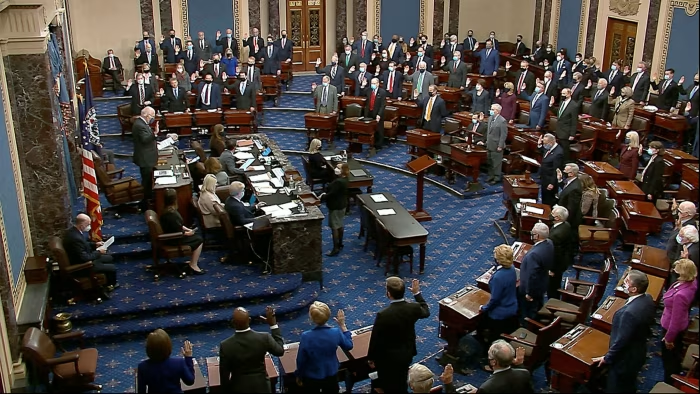
- The U.S. federal government, now in its longest shutdown in history, appears to be nearing reopening. The Senate advanced a bipartisan deal for a stop-gap funding bill to reopen most government operations.
- The proposed legislation would fund the government up to January 30, 2026, and includes some full-year appropriations (for veterans’ affairs, agriculture, etc) as part of the deal.
- Key congressional steps remain: the House must approve the measure, the Senate must finalise amendments, and the President (Donald Trump) must sign it. Bloomberg notes that reopening is still “days away” rather than immediate. Bloomberg
- The shutdown has already impacted the U.S. economy via delayed data releases, furloughed workers, disrupted services (flight cancellations, benefits delays). Its end is seen as a relief factor for markets. Reuters
Key Themes & Drivers
From a professional-investor perspective, these are the major themes and drivers to monitor:
- Economic momentum and data flow restoration
With the government shutdown ongoing, key economic indicators (employment, retail sales, housing starts) have been delayed or frozen. The reopening will restore data flow and reduce uncertainty. Investopedia - Relief rally and sentiment shift
The markets have responded positively — equities futures are up, safe-haven flows are easing, reflecting optimism that the shutdown head-wind will abate. Reuters - Fiscal-policy and funding risk scale-down
The risk of a prolonged funding lapse is decreasing, reducing tail-risk for the fiscal side. However, this is a stop-gap measure, not a full budget resolution, so structural risk remains. Le Monde.fr - Sectoral impact, especially travel, benefits, government contracts
Certain sectors (airlines, federal contractors, benefits processing, infrastructure spending) that were hit hardest by the shutdown may benefit from reopening. The timing and speed of recovery matter. - Interest-rate / yield implications
With the risk of a shutdown dragging on reduced, and data flows restored, there’s potential for shifts in inflation / growth expectations, which will influence interest-rates, bond yields, and cost of capital.
Investment Implications & Opportunities
Opportunities
- Stocks: Equities sensitive to economic reopening (travel, airlines, hotels, consumer services) may get a near-term boost as the shutdown ends.
- Contractors / Federal-services firms: Companies reliant on federal funding or contracts (defence, infrastructure, federal IT) could see resolution of backlog and resumption of payments.
- Data-dependant sectors: Firms that rely on clean economic data for forecasting (financials, macro-hedge funds) may see reduced uncertainty and improved visibility.
Risks / Cautions
- Stop-gap nature: While a reopening is likely, this is not a full budget solution — until a full-year budget is passed, uncertainty remains.
- Delayed recovery: Even once the government reopens, some services may take time to ramp back up (hiring, benefit processing, backlog). So the recovery may not be immediate or uniform. Bloomberg notes that “flight disruptions and food aid delays are likely to persist until the shutdown officially ends.” Bloomberg
- Over-optimism risk: Markets rallying on a “likely” reopening may be ahead of actual operational recovery; if final votes are delayed or House/President objections arise, the rally may reverse.
- Growth drag: The shutdown has likely trimmed Q4 GDP growth; reopening won’t fully reverse that lost growth. A weaker growth backdrop could dampen expectations.
Tactical Portfolio Moves & Strategy
- Short-term tilt: Increase allocation to travel & leisure, airlines, consumer discretionary on expectation of pent-up demand once federal services resume (e.g., more flights, more grants, etc.).
- Medium-term: Consider adding exposure to companies with strong federal contract exposure (both prime and subcontractors) whose revenues were disrupted.
- Hold/Monitor: Infrastructure-related stocks that depend on federal appropriations — once reopening is confirmed, if appropriations follow, we could see meaningful upside; but until then it’s tactical.
- Hedge: Maintain exposure to safe-haven assets (e.g., high-quality bonds, gold) until the reopening is conclusively passed.
Milestones to Watch / What to Monitor
- Final House vote outcomes and President’s signature on the funding bill.
- Timing of federal agency reopenings and backlog clearances (e.g., benefits payments, contract awards, TSA/FAA staffing).
- Release of delayed economic data (jobs, inflation, retail sales) once agencies return to operation.
- Movement in interest rates/yields as growth and inflation expectations adjust.
- Reaction in impacted sectors (airlines, defence contractors, government services) — earnings or guidance updates referencing the shutdown and restarting operations.
Outlook & Conclusion
This development — the likely end to the U.S. government shutdown — represents a meaningful tailwind for markets and the economy. From a disciplined investor’s vantage point, it reduces a major policy risk, clears data-fog, and lifts the overhang on multiple sectors.
However, the reopening is not automatic, and operational recovery will likely be gradual. While markets are optimistic, it would be prudent to treat this as an opportunity to position, rather than assume a full rebound is baked-in. The time to act is now — adjusting exposures, favouring reopening-sensitive sectors — while maintaining caution around execution and structural fiscal policy risks.