What the Announcement Says
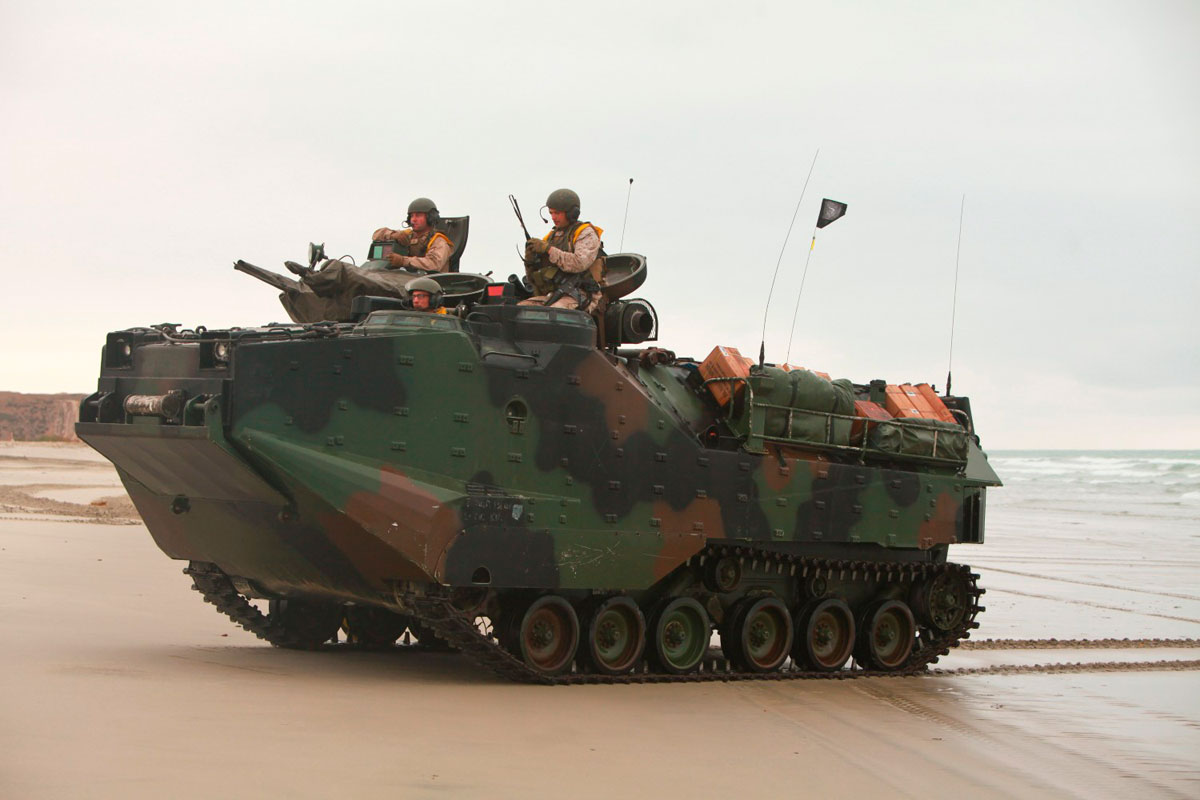
- The U.S. Marine Corps has formally retired the Assault Amphibious Vehicle (AAV) after five decades of service.
- The AAV has been the Marines’ primary amphibious vehicle for transporting troops from ship to shore and across littoral terrain.
- The retirement is part of the broader Marine Corps modernization effort, shifting toward new platforms, doctrine, and capabilities better suited for contested littoral environments, anti-access/area denial (A2/AD) zones, and distributed operations.
- Replacement concepts include vehicles with higher speed, sea state capability, survivability, stealth, unmanned/optionally manned variants, and modularity to adapt to amphibious, overland, and networked warfare.
This is not merely a fleet refresh—it signals doctrinal evolution in amphibious assault, expeditionary warfare, and marine mobility. For defense contractors, suppliers, and investors, it opens windows for new platform development, logistics, sustainment, upgrade, and modernization plays.
Strategic Implications & What’s Changing
1. Shift from Legacy to Next-Gen Amphibious Capability
The AAV has long been criticized for being slow, vulnerable, and ill-suited for high-end contested environments. Its retirement means the Marines are ready to adopt platforms designed for modern threats: missile, anti-ship mines, coastal defenses, long-range precision fire.
2. Opportunity for New Vehicle Programs
Replacing the AAV is not trivial. New amphibious or littoral combat vehicles must balance water speed, sea state handling, armor/survivability, mobility, maintenance, modularity, and networked systems. That’s a big RFP / development pipeline opportunity for primes and subsystem firms.
3. Upgrade & Sustainment Demand
Even as the AAV is retired, existing platforms require decommissioning, refit, parts salvage, and logistics wind-down. Firms adept at military vehicle sustainment, component refurbishment, parts supply, or retrofitting for conversion uses (training, reserve units) may have transitional demand.
4. Doctrine & Procurement Paradigm Shift
This retirement supports a broader change: the Marines are increasingly emphasizing distributed operations, littoral strike, ship-to-shore over contested spaces, unmanned systems, and stand-off mid-range fires. Future procurement will likely prize networked vehicles, autonomous teaming, modular loadouts, and digital integration. Suppliers aligned to that paradigm have advantage.
5. Risk & Competition in Platform Replacement
Compete to win the next amphibious platform program will be fierce. Primes and subsystem firms must differentiate on cost, integration, innovation, risk mitigation, and modularity. Losing a major bid could lock out a decade of revenue.
Investment / Positioning Plays
Here’s how I’d think about structuring investment or tactical exposure around this shift:
A. Core & high-probability plays
- Defense primes / vehicle integrators
Companies already in military land systems or amphibious vehicle markets can leverage experience to compete for next-gen program awards. - Propulsion / marine systems / hull specialists
The marine portion (water mobility) is a key differentiator. Providers of propulsion systems, waterjet design, hull materials (composites, lightweight armor), and hydrodynamic design could be in demand. - Autonomy, robotics, sensor, control systems
Future amphibious vehicles will likely include autopilot, semi-autonomous navigation, sensor suites, integrated control systems, and modular payloads. Firms in autonomy & sensor fusion may benefit from vehicle integration opportunities. - Advanced materials & modularity systems
Lightweight armor, corrosion-resistant composites, modular mission bays, plug-in electronics, scalable architectures—all are tech enablers for future amphibious platforms.
B. Transitional / support plays
- Sustainment, upgrade, decommissioning firms
Companies that service, retrofit, or recycle legacy AAV systems or supply parts during the transition period will see short- to medium-term opportunity. - Training & simulation providers
As new platforms come online, simulator, virtual training, system integration and scenario emulation tools may see increased demand. - Marine / naval systems partners
Integration with ships, amphibious ships, docking, launch systems, connectors, interface gear will matter. Firms supplying those join the value chain.
C. Defensive / hedging exposure
- Vehicle manufacturers heavily exposed to legacy systems only
Firms that rely solely on legacy or traditional vehicle platforms with limited modular or amphibious capabilities may face revenue drop; hedge or reduce exposure. - Component suppliers with weak adaptation potential
Suppliers that cannot evolve to next-generation marine / amphibious performance specs may be at risk of being left behind.
Risks & Execution Challenges
- Technology integration risk: Waterborne performance, sea state handling, hull design, propulsion, weight/armor tradeoffs are complex. Getting the balance right is difficult.
- Cost escalation & schedule slip: Past defense vehicle programs often suffer overruns. The increased complexity of amphibious, modular, networked platforms may widen that risk.
- Certification, testing & reliability: Sea trials, corrosion, maintenance cycles, diagnostics, redundancy—all challenging in harsh marine environments.
- Budget & acquisition risk: Congress or defense budget constraints could slow or reduce funding for next-gen programs. Flexibility in modernization cycles may be limited.
- Competition & bid wars: Multiple primes, international entrants, alliances will compete aggressively. Technical differentiators will matter, but also risk appetite and pricing.
Scenario & Value Potential
| Scenario | Assumptions | Outcomes / Value Capture |
|---|---|---|
| Base | A formal solicitation is released within 2–3 years, multiple bidders, moderate budget allocation, phased fielding over decade | Sustained multi-decade procurement, high-margin integration work over 10+ years |
| Upside / bluewater dominance | Accelerated program, export potential to allied forces, modular export variants, supportive defense policy | Higher-than-expected scale, export markets, premium pricing, sustained upgrade pipelines |
| Downside / stalling | Technical or cost issues delay program by 5+ years, funding constraints reduce scope | Lower incremental value, slow transition, extended sustainment of AAV fleet |
Key Signals & Milestones to Watch
- Release of RFP or solicitation for next-gen amphibious assault vehicles.
- Prototype development announcements, prototype contracts, test demos in sea trials.
- Budget line items in U.S. DoD / Marine Corps modernization plans (Procurement, RDTE) for marine mobility / amphibious programs.
- Awards of subcontractor packages (propulsion, hull systems, autonomy, sensors) for amphibious vehicle development.
- Export or allied interest: whether foreign marine forces (e.g. UK, AU, Japan) express intent to adopt or co-invest in replacement platforms.
- Regulatory reviews or environmental impact statements for marine trials, beach landing systems, amphibious testing areas.
Bottom Line
Retiring the AAV after 50 years is not just a lifecycle decision—it’s a signal that the Marine Corps is pivoting toward a newer generation of amphibious capability tailored for contested, high-threat littoral warfare. For investors, it opens a multi-decadal procurement, modernization, and component play. Success will lie in firms that can deliver modular, marine-capable, autonomous, and domain-adapted systems. The upstream risk is high, but so is the upside if some of these next-gen contracts land over the coming decade.