
Today’s 3 are pretty solid window into the future, war budgets, digital currency flows, and international defence deals. Block’s push against hidden financial rails is a fight over who owns the plumbing in fintech. The NDAA move resets who gets funded in defense across emerging tech, autonomy, and weapons. And the Ukraine-U.S. drone deal turns the old arms export model on its head—battle-tested tech flowing into U.S. forces. For investors: lean into the plumbing and modular layers (data aggregation infrastructure, subsystem suppliers for defense & drones), bet on early wins in prototyping/autonomy, and maintain optionality around policy or contract pivots.
Good: Jack Dorsey / Block pushing at card network fees

What it is:
Bloomberg reports that Jack Dorsey’s Block (formerly Square) is taking aim at the hidden fees in the credit / card network system. The premise: data aggregators (which fintechs use to connect user accounts, payments, balances) might be forced to pay tens to hundreds of millions in “data access fees” by big banks. Block, PayPal & others got hit in the narrative initially, but now they’re pushing back. Block’s stock jumped after analysts pushed back on the worst case. The move is part of a broader Dorsey playbook: owning more of the rails, pushing cost transparency, and possibly extracting rents from infrastructure layers.
This play echoes earlier lawsuits by Block vs. Mastercard/Visa over interchange fees, so it’s consistent with Dorsey pushing against legacy financial tolls.
What it will do:
- Pressure on bank / aggregator margins: If fintechs are forced to take on more of the data-connector cost, margins compress. Banks may try to shift costs back to fintechs or reprice services.
- Regulatory & litigation risk rises: This kind of fight could provoke regulatory scrutiny on payments infrastructure, data rights, and antitrust exposures (e.g. network dominance).
- Fintechs rearchitect stack: Fintech firms may try to internalize more of the data / aggregation layer to escape fee chokepoints (building API layers, data infrastructure). Those who can vertically integrate will gain advantage.
How you can benefit:
- Own fintechs with vertical control: Block, PayPal, and others who already own parts of their stack may absorb these pressures better. If they can push “network rent” capture (e.g. data layer licensing), that’s upside.
- Bet on infrastructure alternatives: Tools that reduce dependence on big bank aggregators—open banking APIs, alternative data access layers, secure aggregation infrastructure—could see strong demand.
- Hedge downside plays: If fintech margins get squeezed, players with weak balance sheets might suffer. Use options or pairs to hedge exposure in fintech names with high aggregator dependence.
Bad: Senate passes ~$914B defense policy bill (NDAA 2026)
What it is:
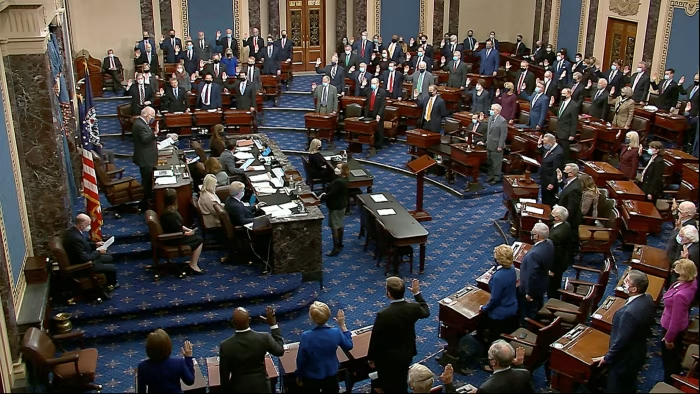
Breaking Defense reports the Senate passed its $913.9B / ~$914B version of the fiscal 2026 National Defense Authorization Act (NDAA), overcoming amendment gridlock. Senators voted 77–20 to send it into conference with the House.
This is a big deal. NDAA sets policy, acquisition priorities, force posture, and modifies programs across Air Force, Navy, Army, space, cyber, and more. It’s also often a place where emerging tech (AI, autonomous systems, hypersonics) gets priority language or guardrails.
What it will do:
- Budget clarity (kind of): With the Senate version in place, committees can negotiate final tradeoffs—programs with bipartisan support (ships, munitions, C4ISR) are more likely to survive.
- Acquisition reforms possible: The bill may include streamlined authority for emergent tech contracts, rapid prototyping, or commercial tech insertion—lowering friction for defense tech firms.
- Program winners & losers: Some legacy or controversial programs may be trimmed; high-visibility domains (cyber, AI, unmanned systems) might get boosts. Contractors will be watching the conference version closely.
How you can benefit:
- Prime / subsystem exposure: Bets on companies supplying across prioritized domains—radars, communications, AI/autonomy, space, logistics, munitions—are good candidates.
- Early prototyping gains: Firms with rapid prototyping cred or small-program wins might leverage NDAA language (e.g. “other transaction authorities”) into larger contracts.
- Volatility around conference results: The final compromise will shift funding; watch for rebalancings, supply contracts, and merger/acquisition triggers when the bill finalizes.
Ugly: U.S. & Ukraine preparing a deal to share drone tech

What it is:
Semafor reports that the U.S. is negotiating a somewhat inverted arms deal: Ukraine supplying drone / UAV expertise / tech to the U.S., in return for U.S. arms/financing. In practice, Ukraine has become a leader in cost-effective, battlefield-tested drone systems (especially at scale, swarm tactics) since 2022. Ukraine’s defense industry has grown ~350% since the invasion, and they’ve innovated in low-cost drones and autonomous tactics. The proposal: buy those lessons / designs, co-produce, scale for U.S. forces.
What it will do:
- Tech transfer reversals: Rather than unilateral U.S → Ukraine, this blurs the flow: battlefield-hardened tech becomes exportable. U.S. gets access to high-tempo, resilience-tested designs.
- Industrial & doctrine updates: The U.S. military may integrate more small drone / swarm / low-cost tactics, shifting procurement and R&D emphasis.
- Competitive signal: Allies and rivals will watch this: if U.S. embraces Ukraine’s designs, it may accelerate drone adoption and modular autonomy competition.
How you can benefit:
- Drone / autonomy plays: Suppliers of sensing, AI control, swarm software, edge compute, communication linksbecome more investable under this reversal dynamic.
- Co-production / manufacturing tailwind: Firms in defense manufacturing (UAV airframes, subsystems) that can scale under U.S.–Ukraine joint programs can see multi-year orders.
- Strategic optionality: If the deal is big and visible, it could catalyze more drone exports and demand; position ahead of treaty/contract signatures via small bets.