

Good: JPMorgan Still Bullish on the Energy Transition

What it is:
JPMorgan is reaffirming its belief that the global shift away from fossil fuels toward clean energy remains a powerful structural trend, despite headwinds. The bank argues that we’re entering a “new energy security age,” driven by surging electricity demand, geopolitics, and climate policy, even as some governments and political actors attempt to roll back clean energy regulation. The report cites continued investment in things like renewables (solar, wind), hydrogen production, EV infrastructure, battery storage, and grid modernization. JPMorgan is advising clients to build exposure now.
What it will do:
- Accelerated clean energy build-out: Driven not just by climate but by security imperatives—countries will prioritize supply chain control.
- Fragmented global energy order: We may see rival blocs (U.S./Europe vs China-led) forming around technology standards, mineral access, and grid networks.
- Capital flows toward transition projects: JPMorgan notes foreign direct investment is already surging into renewable energy markets like India, with $3.4B in 2025 so far.
How you can benefit:
- Critical minerals: Lithium (Chile), cobalt (DRC), nickel (Indonesia) remain choke points; upstream miners and refining firms will remain in high demand
- Grid & infrastructure firms: Companies building cables, substations, and transmission are now central to energy security strategies.
Bad: Schiebel Expands Drone Lineup with Armed Variants

What it is:
Austrian drone manufacturer Schiebel recently unveiled two new armed variants of its well-known Camcopter line: the S-101 and the larger S-301. These are rotary-wing, vertical-takeoff unmanned aerial systems (UAS) modified to carry weapon payloads (light missiles or rockets, guided munitions, etc.), plus upgraded sensors for reconnaissance, surveillance, and targeting. The S-101 builds on the older S-100 frame, adding hardpoints for LMM missiles from Thales; the S-301 is scaled-up with enhanced payload options. Deployment is targeted to begin as soon as 2026. European nations, many of which already use the S-100 for ISR and maritime missions, are evaluating these new variants.
What it will do:
- Expansion of tactical strike drone market in Europe: as borders, maritime zones, and hybrid conflict scenarios demand more flexible airstrikes.
- Shift in defense procurement priorities: countries may re-budget for weapons-carrying UAS, not just surveillance drones.
- Regulatory and export control pressure: Armed drones raise issues around rules of engagement, export licenses, and international norms.
How you can benefit:
- UAS manufacturers: Schiebel is a direct candidate; other players with payload capacity / weapons integration may gain tenders.
- Weapon systems & sensor suppliers: Companies offering missile subsystems, targeting sensors, laser designators, IR/EW modules.
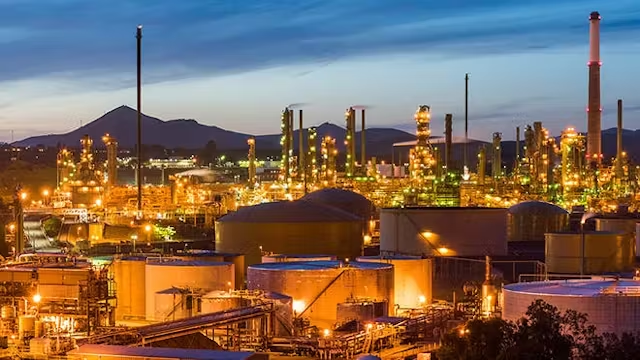
Ugly: California Gas Prices and Refinery Challenges
What it is:
California is facing shrinking in-state refinery capacity (≈ 17-20%) due to upcoming closures (e.g. Phillips 66 in Los Angeles; Valero in Benicia) and refinery conversions to renewable fuel production. To address supply challenges and rising gasoline prices, the state passed SB 237, enabling up to 2,000 new oil well permits annually in Kern County starting in 2026 to boost local crude supply.
What it will do:
- Higher gasoline prices likely: With less refining capacity and more dependency on imports, California faces the risk of price spikes (potentially much higher per gallon than current levels) especially if supply disruptions or transportation costs rise.
- Greater import reliance: As local refining drops, more gasoline and blendstocks will come from overseas or other U.S. regions—raising vulnerability to freight/logistics disruptions and cost escalations.
How you can benefit:
- Refining & midstream operators: Companies that still operate refineries or own refining capacity in California may see higher revenues if margins widen with smaller competition. Also, those that adapt (e.g. converting facilities to handle clean fuels) may benefit from state incentives or regulatory relief.
- Importers & blended fuel suppliers: Firms that refine or import CARBOB gasoline blendstocks or finished fuels (domestically or internationally) could profit from California’s increased import dependence.