
What’s Happening
- ExxonMobil is actively opposing a European Union law (the Corporate Sustainability Due Diligence Directive, CSDDD) that mandates companies (both inside and outside the EU) to ensure their supply chains do not harm the environment or violate human rights. Non-compliance could trigger fines of up to ~5% of global turnover.
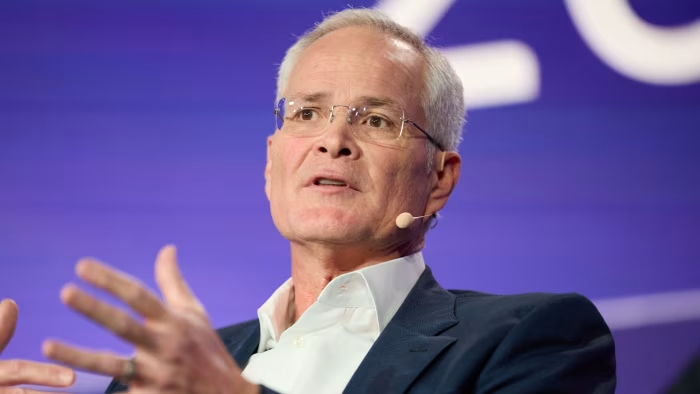
- Exxon’s CEO Darren Woods has criticized the regulation as overly burdensome, calling it “bone-crushing” and arguing that it threatens business competitiveness in Europe. He has taken the matter to U.S. political leadership, making it part of trade-negotiations discussions.
- As a sign of the impact, Exxon has paused or scaled back investments in several European projects—including plastic recycling—citing regulatory risk. The company claims that compliance burdens, ambiguity in enforcement, and potential financial exposure are creating disincentives.
Why It Matters — Strategic Implications & Broader Context
To understand why this is more than just a regulatory complaint, here are the relevant background dynamics:
- Regulation vs. Competitiveness: European regulators are pushing for stricter ESG push across global firms. For companies with large turnover and global operations, compliance cost, complexity, and litigation/operational risk rise significantly. Firms like Exxon are under pressure to balance ESG mandates with cost control and profitability.
- Policy & Trade Intersection: Exxon’s lobbying indicates that such sustainability laws are becoming trade issues, not just moral or environmental ones. Whether U.S. trade policy or bilateral trade negotiations include reciprocity or regulatory compatibility will matter.
- Investor & Reputational Risk: Inconsistent regulatory requirements (different jurisdictions), exposure to non-financial compliance risk (human rights, environment), and shifting public sentiment elevate risk for large, exposed companies. Failure to adapt could lead to financial penalties, litigation, or loss of licenses/social license in certain markets.
- CapEx & Investment Decision Delays: Regulatory ambiguity or compliance cost increase can delay or cancel investments. The fact that Exxon paused a ~$100 million plastic recycling project in Europe is a concrete example: regulatory risk can directly hit planned investments, capex flows, and future growth.
- ESG & Funding Environment: Investors and financial institutions increasingly integrate ESG and sustainability into risk models. Laws like the CSDDD increase the external pressure for companies to internalize environmental and human rights risk and show credible plans for compliance. Companies lagging may face higher cost of capital or divestments.
Investment Plays: What Moves Could Make Sense
From here, these are potential plays for active portfolios, across risk profiles:
| Play | Why It Might Work | Signs to Monitor |
|---|---|---|
| Defensive positions in exposed firms | Big energy, materials, or industrial firms with global supply chains that could be heavily impacted by litigation or non-compliance risk. Those with weaker ESG reporting may underperform. | Watch disclosures on supply chain due diligence, litigation risk, regulatory fine exposure. Also observe restructuring of business lines vs Europe exposure. |
| Companies ahead of compliance curve | Corporates with strong internal ESG programs, clear supply chain transparency, reconciled practices; potentially lower execution risk and less regulatory drag. | ESG ranking/ratings improvement, sustainability reporting, supply chain audits, upstream transparency; participation in trade or tech standards bodies. |
| Legal / compliance advisory firms | Increased demand for legal help, compliance tools, ESG audit services. As firms scramble, service providers may see outsized growth. | New hires, deal announcements, revenues from compliance services; funding or acquisitions in ESG legal/advisory sector. |
| Sustainable plastics & recycling infrastructure | Firms that can demonstrate strong circularity credentials, low emissions footprint, and compliance readiness might get preferred access. Ex-planning projects could be revived with clear regulation. | New recycling project announcements, policy clarifications, clarity on recycled content certification, offtake agreements. |
| Trade policy / regulation arbitrage | Companies or jurisdictions with clearer, more favorable regulatory regimes may attract capital, operations, and investment. For example, firms relocating or exporting to/from jurisdictions with lower regulatory compliance risk. | Capital flows, corporate announcements of shifts in supply/production bases, trade disputes, regulatory equivalence decisions. |
Risks & Potential Headwinds
Even the best-positioned plays come with nontrivial risks. Key areas to watch:
- Regulatory enforcement uncertainty: Even when laws are passed, how strictly they’ll be enforced (which firms, how far down in the value chain, how much oversight) remains murky. Overestimating enforcement leads to overpaid compliance or misallocated strategy.
- Policy backlash / political risk: Regulators in Europe might adjust or weaken regulations in response to business pressure, public cost concerns, or trade conflicts. Rules could get watered down, delayed, or reformed unfavorably.
- Operational & implementation risk: Compliance often requires overhauling supply chains, auditing, procurement changes, and documentation. These are costly, time-consuming, and error-prone. Firms may face unexpected liabilities (not just fines but lawsuits, refusals in customs or procurement) if compliance is partially done or inconsistent.
- Commodity & cost inflation pressures: ESG compliance, recycled content rules, supply chain transparency all add cost. In tight margin sectors (plastics, chemicals, etc.), higher input or compliance cost may depress profitability or force lower margins/sales.
- Brand & reputational risk: Heavy criticism from activists, NGOs, or even governments when companies are seen as resisting climate responsibility can damage brand or lead to consumer or investor backlash.
Return Scenarios & Measurements
Here are how things might unfold, bridging timelines, and what outcomes might look like in terms of returns and risk:
| Scenario | Key Assumptions | Likely Outcome / Return | What Could Go Wrong |
|---|---|---|---|
| Base | EU retains the law with moderate compliance requirements; U.S. joins trade dialogues; firms adjust investment strategies but maintain major operations in Europe; regulatory clarity improves over 1-2 years. | Moderate share price resilience for firms that adapt early; cost of compliance becomes a known line item; capital shifts toward sustainability-friendly sectors; possible re-rating for companies with strong ESG credentials. | Delays in regulations or uneven enforcement; companies misjudge compliance cost; asset write-downs; regulatory reprisals; multinational tensions. |
| Upside | EU reverses or scales back the law under business & trade pressure; harmonization between U.S. and EU regulations reduces duplicative compliance burden; strong policy incentives or subsidies for compliant firms. | Firms resisting now might regain investment momentum; cost of doing business in Europe remains reasonable; ESG-aligned players see premium valuations; investor sentiment improves. | EU maintains strict enforcement; trade retaliation; further tightening of regulation; rising compliance costs eroding margins; capital flight from Europe. |
| Downside | Regulation fully enforced with heavy fines; many firms pull back from Europe; capex in Europe drops; business lines terminated or scaled back due to non-compliance risk; trade tension escalates. | Companies heavily exposed suffer margin hits and share-price declines; firms unable to adapt lose contracts; some investments may become stranded; legal/litigation costs mount. | Severe policy fragmentation; backlash from citizens over cost of energy or goods; supply chain disruptions; reputational damage for major multinationals. |
KPIs & Signals to Track
To stay ahead of how this plays out, here are metrics and signals I’d use to track risk and opportunity:
- Public statements, regulatory filings, earnings reports about compliance (CSDDD) cost, or risk exposure.
- Project cancellations, pauses, or announcements in Europe—especially ESG-adjacent capex.
- Legislative action in the U.S. invoking trade or regulatory countermeasures against EU requirements.
- Moves by companies to reconfigure supply chains, sourcing, or relocate operations outside of EU or develop EU-friendly subsidiaries.
- ESG ratings updates, including human rights / environmental risk in supply chains; audited disclosures.
- Input cost inflation for raw materials tied to sustainability or recycled content; downstream product pricing shifts.
Bottom Line
ExxonMobil’s push to repeal or weaken Europe’s sustainability due diligence directive reflects a broader fight over how regulatory burdens, environmental standards, and trade policy intersect. For investors, the story is not binary—it’s about who adapts fastest, who absorbs compliance costs most efficiently, and who can credibly align business strategy with evolving sustainability expectations while maintaining competitiveness.
In short: regulatory risk in Europe is real and rising. Companies with clarity of exposure, adaptive leadership, and strong ESG credentials will fare better; others may suffer value erosion. For portfolios, this suggests reallocating toward firms and sectors with lower regulatory friction, high compliance readiness, and optionality in production/geography, while hedging exposure in high-risk configurations.
My View
Given what’s known:
- I believe there will be some regulatory tightening, but EU directions suggest pushback and likely compromises.
- Companies that paused investment (like in recycling) are sending warnings that policy can directly block capital deployment.
- Long term, sustainability regulation is not going away; the cost of non-compliance will likely increase. But investment cycles, corporate lobbying, and trade negotiation may delay full enforcement.